
Creators on Creating: Patrick Sylvain
"Remember that you are a transitional being—a provisional presence among countless other provisional beings."

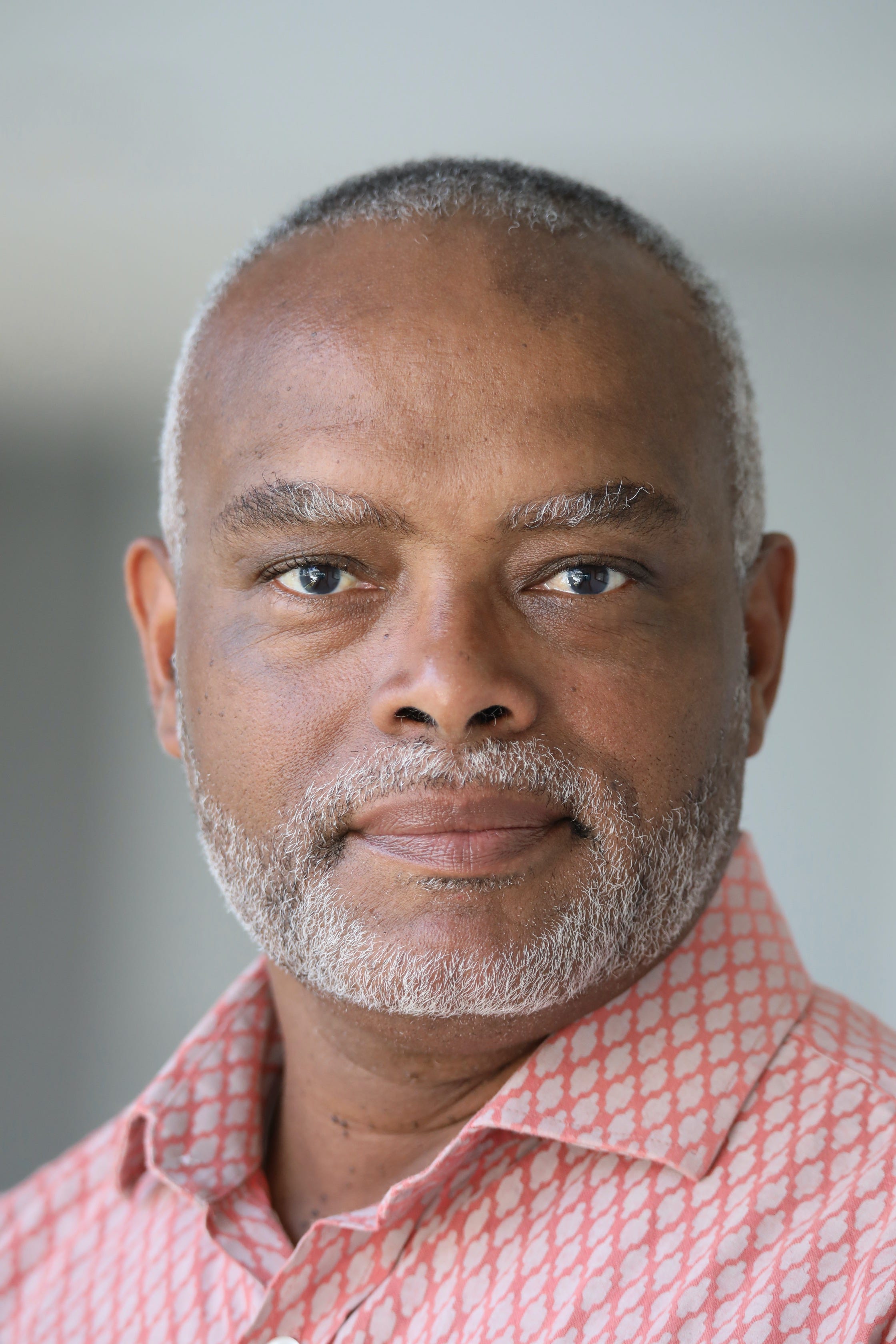
Patrick Sylvain is a Haitian-American educator, poet, writer, social and literary critic, and translator whose work explores Haiti and the Haitian diaspora’s culture, politics, language, and religion. The author of several poetry collections in English and Haitian, Sylvain’s poems have been nominated for the Pushcart Prize and appear in leading journals including Ploughshares, Callaloo, Transition, Prairie Schooner, AGNI, American Poetry Review, Barricade, SpoKe, The Caribbean Writer, and African American Review. His short stories are also widely published. He holds degrees from UMass Boston, Harvard, Boston University, and Brandeis University, where he was the Shirle Dorothy Robbins Creative Writing Prize Fellow. Sylvain recently taught Global, Transnational, and Postcolonial Literature at Simmons University and served on Harvard’s History and Literature Tutorial Board. As of Fall 2026, Sylvain is Associate Professor in the Department of Women’s, Gender, & Sexuality Studies, and Director of the minor in Human Rights at UMass Boston. His publications include Fire on the Tongue (Arrowsmith Press, May 2026), Habits of Light (Finishing Line Press, August 2026), A Critique of Haiti's Political Leadership: Scorched Pearl of the Antilles (Palgrave Macmillan, August 2026), Education Across Borders (Beacon Press, 2022) and Underworlds (Central Square Press, 2018). Forthcoming works in 2026, and 2027 include: a poetry collection from Central Square Press (Unfinished Dreams / Rèv San Bout), and an academic book from Bloomsbury Academic (Five Drum Majors of Haitian Poetry: Literary and Historical Consciousness).
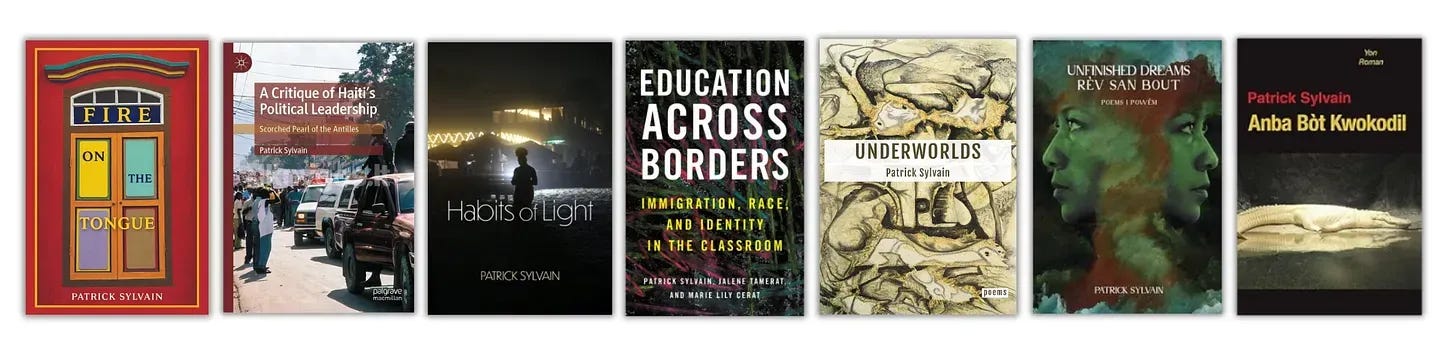
Congratulations on your recent book, Fire on the Tongue, out from Arrowsmith Press! How did this book come to be? Could you share a bit about the title?
The idea of a title is deeply personal. A title resonates when it captures both the tone and the emotional landscape of a book. In the case of Fire on the Tongue, the title was selected by Arrowsmith Press editor Askold Melnyczuk after several rounds of discussion and consideration. It comes from a line in one of my poems. When I saw it alongside three other possibilities, I was immediately drawn to it. It seemed to embody the spirit of the collection—its urgency, its lyricism, and its emotional temperature. A good title becomes the reader’s first point of entry into the work, a kind of signpost that hints at the journey ahead. In the end, I believe a good editor does not impose a vision but reveals one. They help the writer see the work more fully.
Did you write the poems in this collection in English? You also write and translate in Haitian Creole. How do you decide what language to write in? Are some things better expressed in one language than the other?
Writing, for me, is an act of consciousness. It is a way of recognizing the power of words while confronting the histories and structures that shape human life. Some questions I explore can be expressed equally well in Haitian Creole or English. Over time, however, I have come to accept that I write mostly in English because of the literary communities I inhabit, the audiences I engage, and my academic responsibilities. Having lived for many years within North American culture, its linguistic rhythms have become central to my creative impulses.
At the same time, I continue to write in Haitian Creole because it keeps me psychologically and linguistically connected to my origins. It reminds me who I am beyond geography and profession. Writing in English also carries an ethical responsibility because of the economic and cultural power associated with the language. That awareness compels me to witness, to testify, and to seek release from the weight of history. Regardless of language, writing is ultimately the pursuit of truth and an act of freedom.
In “Pyramid of Words,” you write: “I seek words to speak for scorched tongues…words to cleanse the infection of the conquerors’ languages.” Could you share how Haiti’s history of colonial oppression emerges in your writing?
Haiti’s history is never merely historical for me—it is lived memory. Colonialism, revolution, occupation, dictatorship, migration, and resistance continue to shape the emotional and political landscape of Haitian life. My poems often explore how these histories remain inscribed upon bodies, languages, and landscapes.
When I write about “the conquerors’ languages,” I am not rejecting language itself; I am interrogating the histories embedded within it. Language carries memory, but it also carries violence. Poetry allows me to examine those tensions while imagining possibilities for healing, dignity, and liberation. Rather than offering historical commentary, I try to reveal how history continues to live within ordinary human experience.
There seems a constant duality that runs through your poems. You explore the beauty of the sea, the magic of the circus, what your grandfather taught you—yet also of the sinister undercurrent of danger, the violence of whipped animals, and being whipped yourself. Is this duality simply what living is? Maybe you could speak to this power of yours to not shy away from what is hard and complex.
I believe life is inherently paradoxical. Beauty and violence often exist side by side. The sea can be both nurturing and destructive. Childhood can contain wonder alongside fear. Love and suffering frequently inhabit the same memory.
I’m not interested in simplifying those contradictions. Poetry, for me, is a space where complexity can exist without demanding immediate resolution. If the poems possess any power, I hope it comes from their willingness to remain with difficult truths rather than turning away from them. Human experience is rarely singular, and poetry should honor that multiplicity.
Some of your poems reference being whipped as a boy by your grandfather. “You wanted a man erected from a boy, / my legs sculpted by staccatoed lashes.” You write of the violence with moving lyricism, it seems like an act of transformation of something incredibly painful into your breathtaking poems. Could you speak to the process of diving into your past? And what it brought up for you?
Memory is not an archive of fixed facts but a living process of interpretation. Returning to childhood, including painful experiences, requires both honesty and compassion. Poetry does not erase suffering, nor does it justify it. Instead, it allows me to transform experience into language that may create understanding rather than silence.
Writing about those experiences also reminds me that personal history is never purely individual. Family histories, cultural expectations, migration, and historical forces all shape who we become. Revisiting the past is therefore not simply an act of remembrance but also an attempt to understand how identity is continually being formed.
You’re “an Atlantic diasporic molded & shaped / By circumstances, constantly shift-shifting / To survive parasitic waves.” Where is home for you now? Do you feel at home in Boston?
Home has become less a fixed geography than an evolving relationship between memory, language, and community. Haiti remains my emotional and cultural foundation, but migration has taught me that one can belong to more than one place while never belonging completely to any.
Boston has become an important home for me. It is where I have developed lasting friendships, have a family, built an academic life, and grown as both a writer and a teacher. At the same time, my relationship to Boston remains informed by my diasporic experience. Home, for me, is not simply where I live but where I can think, write, teach, dream, and contribute meaningfully to the lives of others.
How has living in Boston influenced you and your writing?
Yes, absolutely. Boston is a wonderfully complex, intellectually vibrant city. Here I have encountered people from many different backgrounds and perspectives, experiences that continually challenge and expand my thinking. The city encourages me to imagine new possibilities while also deepening my appreciation for Haiti’s revolutionary history, especially the historical connections between Boston and Haitian leaders during the Age of Revolution.
How have you found community as a poet and writer?
I have been fortunate to belong to communities of writers who challenged, encouraged, and nurtured my development. Those relationships have shaped not only my writing but also my understanding of what it means to live a literary life.
The first community that proved essential to my growth was the Dark Room Writers Collective. Through that collective I had the privilege of meeting writers such as Yusef Komunyakaa, Martin Espada, Ntozake Shange, Derek Walcott, and many others whose generosity and example opened entirely new literary paths for me. Writing may appear solitary, but literature itself is profoundly communal.
Your poems seem to recognize and fully explore the potentiality and limits of language. Could you speak to your relationship with language over time? What can language do and not do?
Language has become increasingly mysterious to me. The more I write, the more I recognize both its extraordinary power and its limitations. Language can preserve memory, resist oppression, inspire compassion, and imagine new worlds. Yet it can also conceal truth, justify violence, and reinforce systems of domination.
My relationship with language has therefore become one of humility. I no longer believe language can fully capture reality. Rather, I think poetry approaches truth asymptotically—it moves toward it without ever completely possessing it. That uncertainty is precisely what keeps me writing.
What does your writing process look like?
I write almost every day. As I’ve grown older, I demand greater rigor from my language. I’m deeply interested in how words act upon the psyche and how they shape—and are shaped by—our collective human experience.
I don’t follow a strict routine. When I write successfully, it is usually late at night or very early in the morning. Those quiet hours create a space where language can emerge with fewer distractions.
Do you have any favorite writing habits or rituals?
My process is highly iterative. I move through many drafts, often beginning with fragments—an image, a phrase, a rhythm, or a particular tonal gesture. Those fragments gradually suggest an internal architecture that the poem is attempting to build.
Revision is where the real writing occurs. I frequently dismantle poems before rebuilding them. I also read aloud constantly. Poetry must satisfy not only the eye but also the ear. Sound often reveals weaknesses that silent reading cannot.
How have your many book projects come to be?
Each book has emerged from a different set of questions rather than from a predetermined plan. My work consistently returns to language, history, consciousness, migration, and power. I’m interested in how language reveals and obscures truth, how memory survives displacement, and how systems of power shape individual lives.
Increasingly, my questions revolve around belonging, migration, and the ethics of representation in a fractured—and often morally compromised—world. I’m fascinated by the extraordinary creativity of human beings alongside our equally remarkable capacity for destruction through structural violence, racism, greed, sexism, and other forms of domination. Each project grows from sustained engagement with these questions rather than from a desire simply to produce another book.
You’ve worked with an impressive number of presses: Beacon Press, Central Square Press, Palgrave Macmillan, Finishing Line Press, now Arrowsmith Press. Could you share a bit with our readers your various experiences in publishing? Did any surprises arise? Do you have any advice for writers seeking publication?
I’ve been very fortunate to have grown up in an environment where writers were respected, and where books were regarded as sacred objects. The life of the mind was highly valued in my family and in my neighborhood. It was true when I was growing, and it is still true now that the writer still has a role, though it is neither singular nor fixed. At its most vital, writing bears witness. It interrogates dominant narratives, preserves memory, and creates space for alternative ways of seeing.
Moving between poetry and academic prose is both challenging and generative. Each genre demands a different relationship to language—poetry privileges compression and resonance, while academic prose requires clarity, argument, and exposition. The appeal lies in the tension. Each form sharpens the other. Poetry deepens my sensitivity to language; scholarship disciplines my thinking.
Having my point of view, my reading of the world shared through publications, has been satisfying, surprising at first, and now, I have an obligation to contribute my voice to the public square in a way that is lucid, truthful, respectful, and aesthetically meaningful. Writing is not just the production of words, it is a concert of thoughts—one’s own with others. It is a fine tuning of expressive culture. It is leaving a legacy of and about humans’ creativity and our place in the world. Before you enter that concert stage, you must read carefully. You must listen attentively to what other composers have created. You must understand scale, tone, voice, and the weight of composition. Being a writer is not about appearing fashionable; it is, to some extent, about becoming another Atlas—willing to carry the weight of language, history, and responsibility.
You previously taught as an Assistant Professor in Global, Transnational, and Postcolonial Literature at Simmons University. It’s also exciting to hear that you’ll be starting in Fall 2026 as an incoming Associate Professor in the Department of Women’s, Gender, & Sexuality Studies, and Director of the minor in Human Rights at University of Massachusetts – Boston. What are some of your favorite texts and writers to teach?
I enjoy teaching writers whose works ask difficult ethical and historical questions while remaining formally inventive. Toni Morrison, Colson Whitehead, Mohsin Hamid, Amitav Ghosh, Zadie Smith, Chimamanda Ngozi Adichie, Edwidge Danticat, Jamaica Kincaid, and Nawal El Saadawi consistently generate thoughtful conversations because they encourage students to think critically about identity, history, migration, gender, power, and memory. I hope students leave my classroom not simply with more information but with a deeper capacity for empathy and critical inquiry.
Who are some of the writers or books you hold most dear?
Writers who engage both the lyrical and the political have been central to my development—those who refuse to separate aesthetics from history. I’m drawn to voices that challenge language while remaining accountable to lived experience. I admire writers who refuse to separate aesthetics from ethics, beauty from history, or imagination from responsibility. The writers who remain with me are those who deepen my understanding of both language and humanity.
I’m currently reading Fearless by Tracy K. Smith; Imagination: A Manifesto by Ruha Benjamin, and Vision and Difference by Griselda Pollock. I move between these and poetry collections. Poets such as Yusef Komunyakaa, Robert Pinsky, Seamus Heaney, Adrienne Rich, and Bei Dao are very dear to me. Of course, there are several fiction writers (Toni Morrison, James Baldwin, Edwidge Danticat, Amitav Ghosh…) and theorists (Michel Foucault, Karl Marx, Martin Heidegger, Sylvia Wynter, Ann Laura Stoler, Jürgen Habermas,…).
Do you have any advice for young writers?
In a culture saturated with information, the writer’s task may be less about producing more content and more about deepening attention. Slow down. Observe carefully. Read widely and generously. Resist easy conclusions. Remain accountable both to language and to the communities whose stories you tell. Above all, be honest—with your subject, with your readers, and with yourself.
Do you have any life advice in general?
Try to be a decent human being. Remember that you are a transitional being—a provisional presence among countless other provisional beings. There is nothing inherently superior about any of us. Make your time in this world meaningful by contributing kindness, curiosity, and integrity. Kindness is not weakness; it is one of the highest forms of strength. Live with humility, remain open to learning, and leave the world, however modestly, better than you found it.